
THROWING CAGES FOR ATHLETIC FACILITIES
Throwing cages help contain errant implements and define controlled throwing areas for track and field programs. For schools, colleges, and sports complexes, the right system supports practice and competition while fitting the facility’s layout and schedule.
H2I Group helps clients select and install specialized equipment through trusted manufacturing relationships. As a specialty subcontractor, we coordinate with your construction team to bring throwing cages into your broader athletic solutions plan.
INDOOR THROWING CAGES FOR SHOT PUT AND WEIGHT THROW
Cage selection starts with the events your facility will support. Indoor throwing cages must suit the intended implements, event requirements, and operating conditions. Custom ceiling-suspended systems support shot put and indoor weight throw applications.
Shot put cages and weight throw systems should be evaluated for their specific use. An outdoor discus cage serves a different setting and should not be treated as interchangeable with an indoor system. We’ll help you review equipment options against your program’s needs.
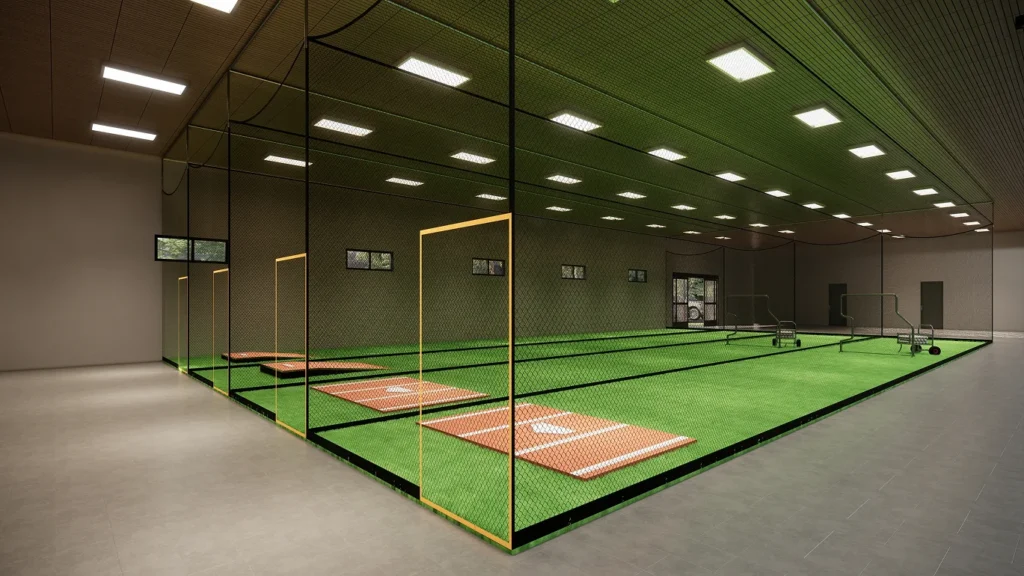
CEILING-SUSPENDED THROWING CAGES
Ceiling-suspended throwing cages use electric operation to raise and lower the equipment. When stored overhead, the cage frees floor space for other activities and reduces the need to move portable uprights and heavy bases.
For fieldhouses with changing daily schedules, overhead storage can simplify transitions between throwing sessions and other programming. The selected system still needs adequate clearance in both operating and stored positions. Controls and operating procedures should also fit how your staff manages the space.
CEILING-SUSPENDED VERSUS PORTABLE SYSTEMS
A ceiling-suspended system may suit a facility that frequently changes activities and has suitable overhead support. Portable systems offer another approach when equipment must be assembled and removed as needed.
Compare the complete setup process, including staff time, equipment handling, and storage space. Portable equipment needs somewhere to go between sessions, while suspended equipment requires coordinated overhead installation. H2I Group can help your team assess the options available for your project.
SPACE AND INSTALLATION PLANNING
Planning should account for the throwing circle, cage opening, landing area, and circulation around the activity. Nearby courts, spectator areas, and other equipment also affect placement. Net dimensions alone do not establish the total space needed.
For suspended systems, the project team must review structural support, attachment locations, electrical needs, and potential conflicts with lights, ducts, or other overhead equipment. H2I Group provides design assist and installation coordination alongside the architect, structural engineer, and general contractor.
NETTING, EVENT REQUIREMENTS, AND MAINTENANCE
Netting must be appropriate for the intended implementation and installed according to the manufacturer’s instructions. Confirm the requirements that apply to your program, including relevant NFHS, NCAA, or USATF rules. Product selection should reflect the planned level of competition.
Routine inspections should address nets, connections, lifting components, and other hardware according to the manufacturer’s guidance. Cages work alongside supervised access and clear throwing procedures. Ask about H2I Group’s service and support options when planning inspections, repairs, and future replacements.
HOW MUCH DO THROWING CAGES COST?
Throwing cage costs depend on the system, dimensions, controls, and installation conditions. A complete project estimate should account for equipment, delivery, installation, and any required supporting work.
Share available drawings, intended events, budget, and schedule early. These details help the project team identify requirements and develop a scope suited to your facility.
PLAN YOUR PROJECT WITH H2I GROUP
From equipment selection and budgeting through installation and closeout, H2I Group brings manufacturers and construction partners together around your goals. We’ll help coordinate throwing cage equipment with the other specialized solutions your space needs.
Contact H2I Group to discuss your throwing cage project, review facility requirements, and plan the next steps.