
Blogs & News
- Category: Athletic
- DATE: September 23, 2026
How Much Is a Turf Field? Cost Guide and Budget Factors
If you are planning a new athletic facility or replacing an aging field, one of your first questions may be, “How much is a turf field?” A full-sized synthetic sports field can cost about $700,000 to $2.5 million, but that broad range is only a starting point. Field size, site conditions, drainage, turf quality, labor, and added equipment all shape the final price.
Understanding those costs early helps school districts, facility managers, architects, and construction partners set a more realistic budget. It also makes it easier to compare estimates and choose a system that fits the way the field will be used.
Artificial Turf Field Cost at a Glance
The artificial turf field cost includes much more than the visible green surface. A complete outdoor system may require excavation, grading, a compacted stone base, drainage, turf carpet, infill, seams, markings, and perimeter details. Indoor projects have a different scope but may still require subfloor preparation, padding, adhesives, and custom graphics.
As an early planning reference, turf materials may cost about $4 to $9 per square foot. Base preparation can add about $4 to $10 per square foot, while installation labor may range from $2 to $7 per square foot. These categories sometimes overlap in contractor estimates, so they should not be added together without reviewing what each line includes.
How Expensive Is a Turf Field?
For a full-sized athletic field, a planning range of $700,000 to $2.5 million is reasonable for many projects. Complex sites, premium systems, extensive drainage, lighting, fencing, seating, or other improvements can push the total higher.
A regulation football playing area, including the end zones, covers 57,600 square feet. The actual turf installation is often larger because it may include sidelines, team areas, run-off space, or nearby training zones. Baseball, soccer, lacrosse, and multiuse fields also have different dimensions and layouts.
Total Project Cost vs. Cost Per Square Foot
Cost per square foot is useful for early comparisons, but it does not tell the whole story. Two fields with the same turf area can have very different budgets if one has stable soil and an existing base while the other needs excavation, soil correction, and a new drainage system.
Ask what the estimate includes. A low square-foot price may cover only the turf surface. A full project estimate may also include demolition, hauling, civil work, permits, testing, equipment, and project management.
What Impacts Turf Field Installation Cost?
The following factors have the greatest effect on turf field installation cost.
Field Size, Sport, and Expected Use
Larger fields require more turf, infill, base material, seam work, and labor. The selected sport also changes the field layout and performance needs. Football, soccer, baseball, and field hockey may require different pile heights, infill systems, markings, and equipment.
For a multiuse field, the project team must decide which sports take priority and how overlapping lines will be handled. A flexible layout may support more programs, but added colors, seams, and markings can raise the initial cost.
Turf, Infill, and Shock Pad Selection
Turf fibers may be made from polyethylene, polypropylene, or nylon. Each material has different performance, durability, feel, and cost characteristics. Product quality, fiber construction, backing, warranty terms, and expected playing hours all influence the selection.
Infill supports the turf fibers and affects traction, firmness, drainage, heat, maintenance, and price. Standard crumb rubber is often among the least expensive options, while alternative infills may cost more. A shock pad beneath the turf adds expense but can help the system meet specified impact-attenuation and performance goals. Organic infill systems may also require a shock pad to meet Gmax and Head Injury Criterion (HIC) performance requirements established by applicable governing bodies.
Site Preparation, Base, and Drainage
Site preparation is often one of the largest budget categories. On a difficult new-build site, excavation, grading, base construction, and drainage can account for 40% to 50% of the installation budget. Poor soil, steep slopes, limited access, or existing drainage problems can increase that share.
The base must be stable, compacted, and built to the project specifications. The drainage system must also move water away from the playing surface at the required rate. Weak base construction or poor drainage can lead to uneven areas, water buildup, and early repairs.
Converting a natural grass field to artificial turf can also affect stormwater permitting. Some permitting authorities treat artificial turf as an impervious surface similar to asphalt, which may require a survey of the property to calculate its total impervious area and demonstrate compliance with local and state stormwater requirements. Depending on the site, compliance may involve acquiring additional land, adding subsurface water retention or constructing a retention pond, potentially adding significant cost to the project.
Labor, Access, and Geographic Location
Labor costs depend on the market, crew requirements, schedule, and site access. Rates often run higher in the Northeast and on the West Coast. Remote sites may face added transportation, lodging, and equipment-mobilization costs.
Base material costs can also vary significantly by location. Stone is typically more expensive in areas farther from quarries, including some coastal regions, because material may need to be hauled longer distances or transported by rail to local storage yards. Projects closer to quarry-rich or mountainous regions may have lower transportation costs.
Project timing is another consideration. Weather, material lead times, site readiness, and coordination with other trades can affect the schedule. A simple surface replacement may take weeks, while a new field with major site work can take several months.
Graphics, Equipment, and Other Additions
Logos, end-zone designs, multiple line colors, and custom field markings add material and labor. The total budget may also include goals, foul poles, batting cages, protective netting, fencing, scoreboards, lighting, seating, padding, or sports storage.
These items should be listed separately during estimating. That gives the owner a clearer view of the core turf field cost and the price of each optional improvement.
Indoor vs. Outdoor Turf Field Costs
An indoor turf project may avoid the excavation and stormwater work required outdoors, but indoor turf installation cost still depends on the existing floor, system type, shock absorption, seam layout, access, and graphics. Some spaces need extensive surface preparation before installation can begin.
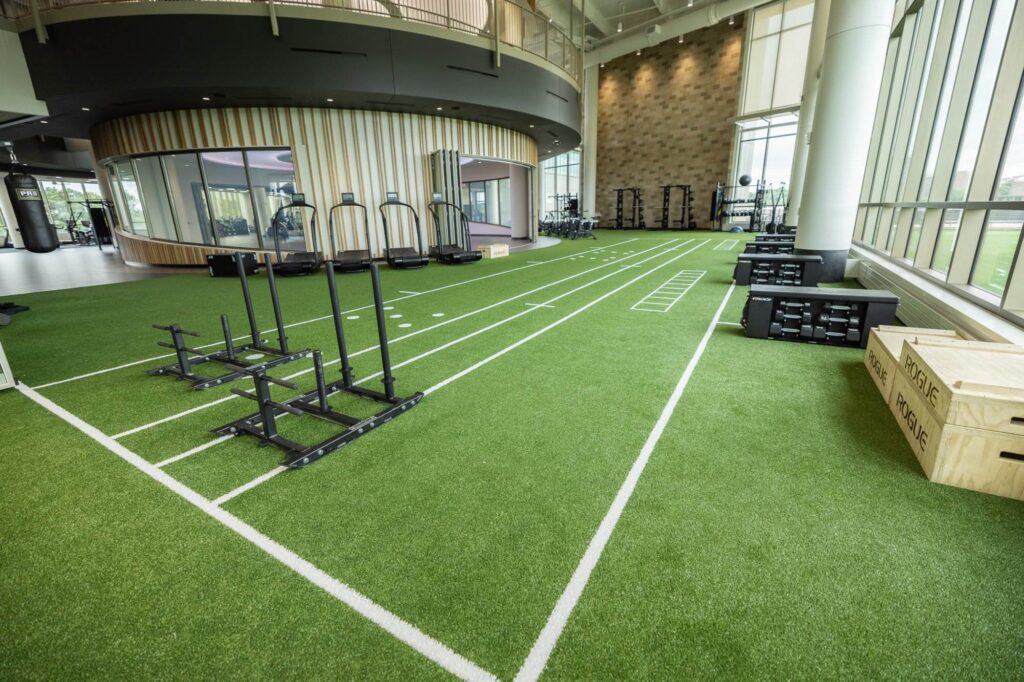
Outdoor fields must account for soil, weather, grading, drainage, and heavier civil work. Indoor systems may place more focus on training performance, sled use, custom markings, and transitions to nearby flooring. H2I Group offers indoor turf systems for team sports, individual training, gyms, fieldhouses, and other Athletic spaces.
New Construction vs. Turf Replacement
A new conversion requires the full supporting system, which may include excavation, base construction, drainage, and new perimeter details. Early budgets sometimes place straightforward new conversions around $7 to $14 per square foot for turf-related work, but complete athletic-field projects can cost much more once civil work and added features are included.
Surface-only replacement may cost about $5 to $10 per square foot when the existing base and drainage can be reused. Their condition must be evaluated before the owner relies on that savings. Repairs to the base, drainage, curbs, or shock pad can increase the replacement budget.
What Does Professional Turf Installation Include?
A professional installation begins with clear performance needs and an accurate scope. The team evaluates the field dimensions, sport requirements, site conditions, drainage, turf system, infill, markings, equipment, schedule, and warranty terms.
Outdoor work may include excavation, grading, drainage installation, base placement, and compaction before the turf is laid. Installers then position the rolls, complete the seams, secure edges, add markings and graphics, distribute infill, groom the field, and complete required testing and closeout tasks. H2I Group provides professional artificial turf installation and coordinates with owners, architects, general contractors, construction managers, and vendor-partners throughout the project.
Turf Field Maintenance Costs
Synthetic turf requires less routine care than natural grass, but it is not maintenance-free. A complete program may include debris removal, brushing, grooming, infill checks, seam and edge inspections, cleaning, decompaction, repairs, and performance testing.
Annual turf field maintenance cost estimates commonly range from about $6,000 to $23,000. Actual spending depends on field size, playing hours, staffing, service frequency, equipment ownership, and the manufacturer’s requirements. Schools and facility owners should also decide whether work will be handled by employees, a service provider, or both.
Lifespan and Replacement Planning
Artificial turf often lasts eight to 15 years with proper care, but heavy use, climate, maintenance, and product quality affect that timeline. A field used throughout the year for several sports may age differently from a field with a shorter season.
Surface replacement may cost $350,000 to $700,000 or more. Owners should begin setting aside replacement funds well before the warranty or expected service life ends. Replacement is usually less expensive than the first installation when the base and drainage remain usable.
Heat and Performance Considerations
Outdoor synthetic turf can become hot in direct sun. Product color, infill, shade, irrigation or cooling practices, local climate, and scheduling may influence a facility’s heat-management plan.
Project specifications may also call for impact testing, including Gmax or other measures. Owners should review testing frequency, warranty conditions, accessibility, maintenance instructions, and applicable local requirements before approving the system.
How to Plan and Budget for a Turf Project
Start with the field’s dimensions, primary sports, estimated playing hours, desired opening date, and available budget. Document existing conditions and determine whether surveys, soil information, or drainage studies are needed. Then develop a scope that separates the turf system from site work and optional equipment.
Compare estimates line by line. Confirm who is responsible for demolition, base work, drainage, turf installation, testing, permits, cleanup, and closeout. Review both the initial price and the expected cost per year over the system’s service life.
Questions to Ask During Estimating and Procurement
Ask prospective project partners:
- What turf, infill, and pad systems fit the facility’s sports and usage?
- What assumptions were made about the existing soil, base, and drainage?
- Which site-work items, markings, equipment, and tests are included?
- What maintenance is required to support performance and warranty coverage?
- What project experience, certifications, and manufacturer relationships does the team have?
- How will the work be coordinated with the architect, contractor, and owner?
Clear answers make it easier to compare scope, value, and long-term support instead of choosing an estimate based only on the lowest total.
Plan Your Turf Project with H2I Group
Every turf field has a different mix of site conditions, performance needs, and budget limits. H2I Group brings more than 100 years of specialty contracting experience, strong vendor-partner relationships, and employee-owner accountability to Athletic projects across the country.
From preconstruction and design assist through estimating, project management, installation, closeout, and service, H2I Group helps construction teams and facility owners bring the pieces together. Explore our complete athletic solutions or contact H2I Group to discuss your field, budget, and schedule.
- Inspect the hood for visible corrosion or damage.
- Verify airflow monitors and alarms are functioning properly.
- Review housekeeping and chemical storage practices.
- Document maintenance concerns and schedule follow-up as needed.
recent blogs
GET STARTED
LET’S TALK ABOUT YOUR PROJECT TODAY
Are you in need of expert guidance for your building project? H2I Group’s experienced professionals are here to assist you with any questions or concerns you may have. Contact us today to learn more about our services and how we can help you achieve your goals.